Birth chart guide
How to Read Your Birth Chart
A birth chart is a circular map of the sky at the moment and place you were born, and you read it in layers rather than all at once. Start with the big three, the Sun, the Moon and the rising sign, because they carry the loudest part of the story. Then look at where each planet fell, which sign colours it and which house gives it a stage. Aspects come last, and they tell you which parts of you cooperate and which argue.
Start here
A birth chart reads in four layers.
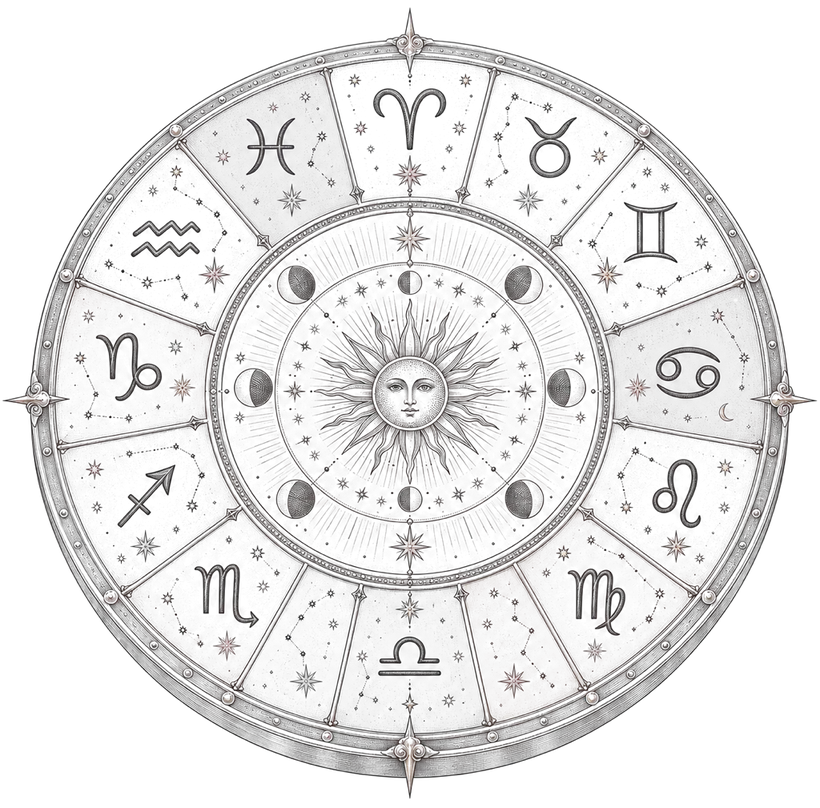
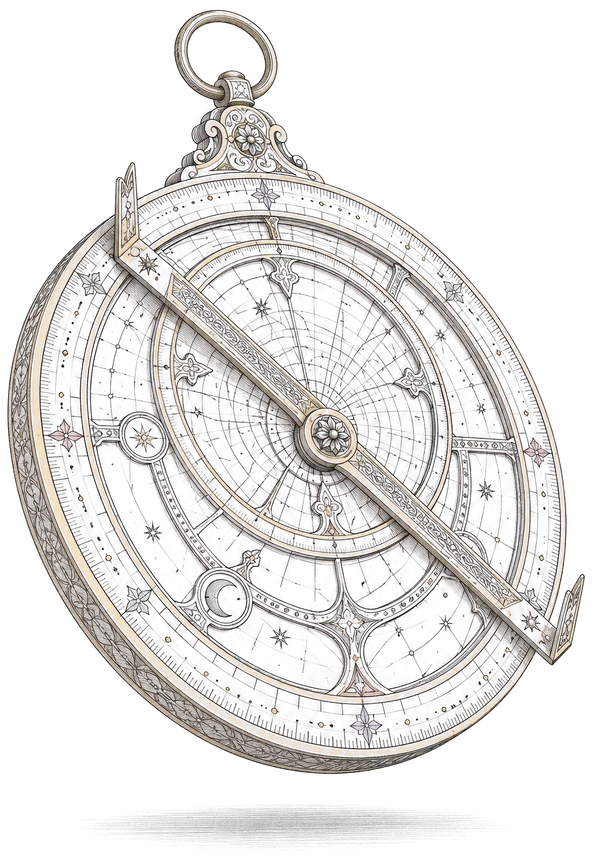
Each layer stands on the one before it, so the order does more work than the speed. The wheel alongside is one example chart, and it belongs to nobody.
The big three
One says what you are growing into, one says what you need when nobody is watching, and one says how the world meets you at the door.
The ten planets
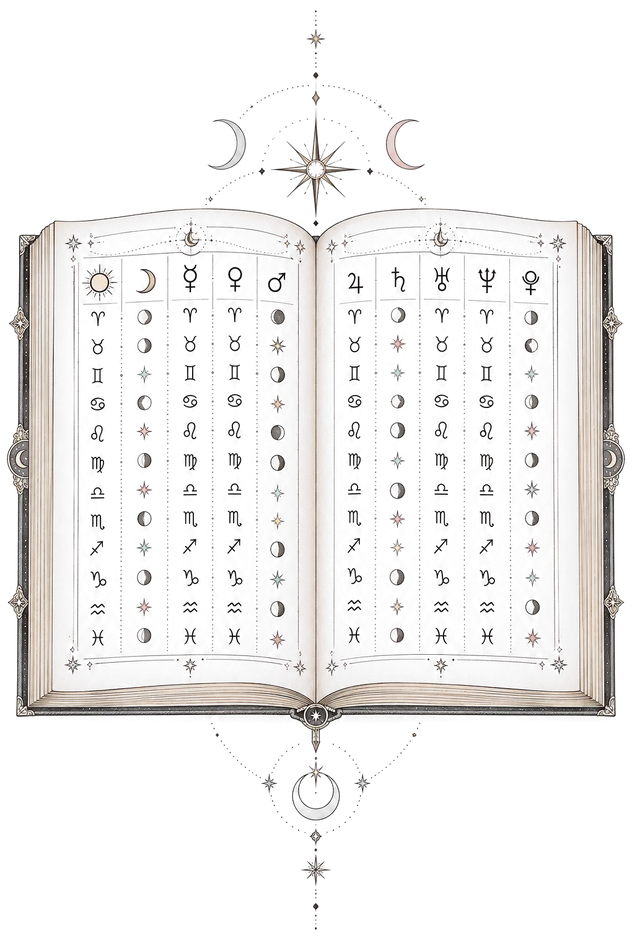
Read the glyph, then the name, then the job. Once you can say what a planet is for in your own words, its sign and its house start to mean something.
The twelve houses
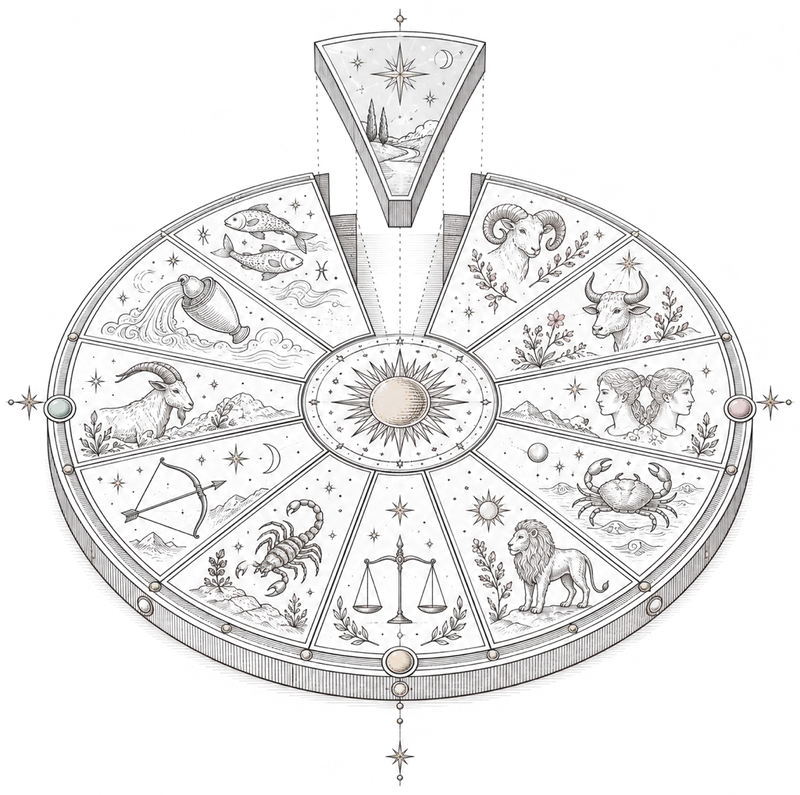
The sign says how a part of you behaves. The house says where in your life it shows up. Ten planets cannot fill twelve rooms, so empty houses are normal.
The five aspects
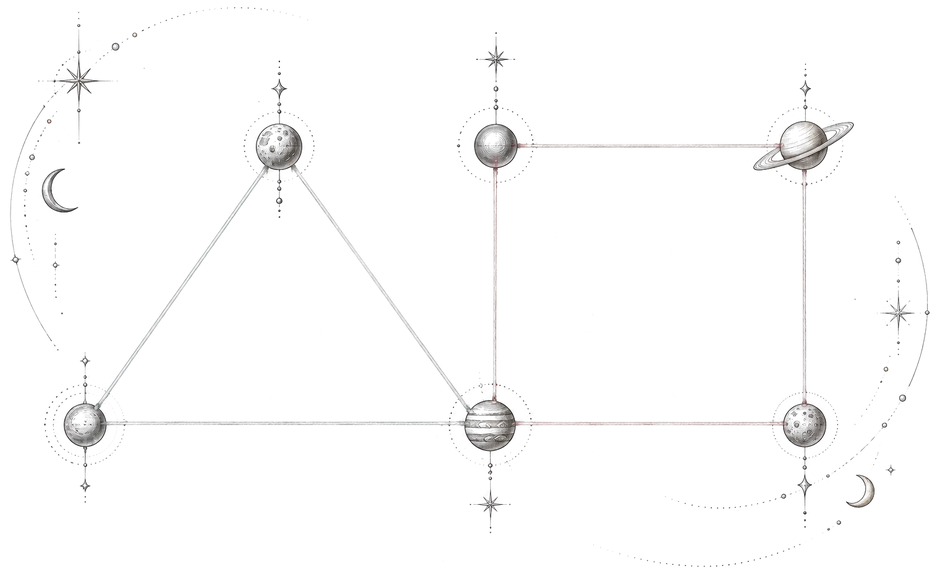
Two planets at a particular angle read as one relationship inside you. Some of those relationships cooperate, some argue, and the arguing ones carry the work.
In practice
Your first birth chart reading.
Get the chart calculated properly
Date, exact time and city, taken from a document rather than from memory. Everything that follows rests on those three facts, and a chart built on a guessed minute will quietly mislead you for years.
Read the big three first
Sun, Moon, rising, in that order, and write down the one line from each that made you uncomfortable. Those three carry most of the recognisable material. Do not move on until you can say your big three out loud and explain in plain words what each of them is responsible for.
Place the personal planets
Mercury, Venus and Mars are the working parts of daily life, how you think, how you love, how you push. Note the sign and the house for each, then say the pair as one sentence. Venus in a fixed sign in the seventh house is a different love life than Venus in the fifth.
Find the two loudest aspects
Ignore the full web at first. Look for squares and oppositions involving the Sun, Moon or rising ruler, and take the two tightest ones. Those describe the arguments you have with yourself. A chart with no tension would belong to someone with nothing to work on, which is nobody.
Turn it into three sentences
Close the chart and describe yourself in three sentences using what you found. If the description sounds like a horoscope, you copied it. If it sounds like something a close friend could have said about you, you read it. Come back in six months and write the three sentences again.
Questions
The four that come up every single time.
Read here as a language of symbols. Medical, legal and financial questions belong with a professional.
Which part of the chart should I read first?
The rising sign, then the Sun, then the Moon. The rising sign comes first because it organises the houses, so everything else lands in a different place depending on it. After the big three, go to the ruler of your rising sign and see where it sits. That one planet often explains more about your life shape than a page of aspects.
Half my houses are empty. Is something missing?
No, and this is the most common worry there is. Ten planets cannot fill twelve houses, so empty houses are the normal state of every chart ever built. An empty house simply means that area of life runs on its own terms without a planet dramatising it. You read it through the sign on its cusp and through the planet that rules that sign.
Why do two calculators give me different houses?
Because there is more than one way to divide a circle. Placidus splits the sky by time and is the default in most Western software, whole sign gives each sign one whole house and is older and simpler. Your planets and signs stay identical either way. Pick one system, learn to read it, and do not switch every time a placement flatters you more.
How long does it take to read a chart on my own?
A usable reading of your own chart takes a few evenings. Reading someone else's chart without leaning on lists takes months, because the skill is not memorising meanings but combining them. A practical shortcut is to read the charts of ten people you already know well. Their lives correct your interpretations faster than any book can.
Where next
Your own birth chart comes next.
The calculator takes a date, a time and a city and gives you the wheel this page just described, with your own planets in it.
Build my chart firstRising signMoon signNorth nodeCompatibility