retreat curatorby milena chernomorets

Meditation

Meditation for Anxiety: A practice for the days when your chest is tight

For mild to moderate anxiety the evidence is decent: eight week mindfulness programmes reduce anxiety symptoms about as much as a standard first line antidepressant in at least one head to head trial, and effects hold in meta analyses. What meditation changes is your relationship to the alarm, not the alarm itself. It also does not suit every state, and sitting with closed eyes in acute panic can make things worse. Movement, grounding and eyes open practice are legitimate versions.

Grounding first, sitting laterNamed: when it makes things worse
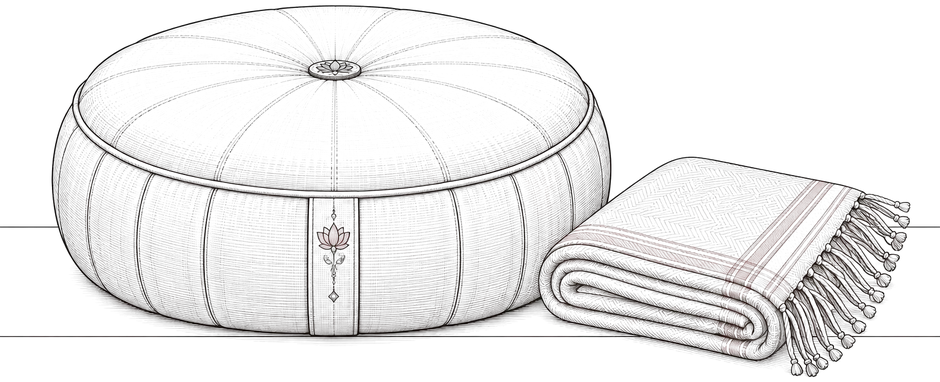
A round sitting cushion and a folded blanket beside it, the floor drawn with two lines

01

What can meditation honestly do for anxiety

Anxiety runs on prediction. The mind rehearses a future threat, the body prepares for it, the body sensations become new evidence that something is wrong, and the loop tightens. Mindfulness practice interrupts the loop at the point where thought becomes fact. You learn to notice a thought as a thought, feel the tight chest as sensation rather than as a verdict, and let both be there without adding a second story on top. The research base is real: structured eight week programmes produce moderate reductions in anxiety symptoms, and in a randomised trial published in 2022 an eight week mindfulness programme was no worse than escitalopram for anxiety disorders. Two caveats keep this honest. Most of the good data comes from taught courses with a teacher and a group, not from ten minutes in an app. And meditation does not remove anxiety, it changes how much of your life it gets to run.

02

How do you ground yourself when anxiety spikes

Grounding works because it hands attention to the senses, which only report the present, while anxiety lives in a predicted future. The classic sequence walks down through the senses. Name five things you can see, and say them slowly and specifically, the dust on the window frame rather than the window. Then four things you can feel against your skin. Then three sounds, near, middle and far. Then two smells, or two you can bring to mind. Then one taste. Say them silently or out loud, whichever is available. Keep your eyes open the whole time. The goal is not to feel calm at the end, it is to be here at the end, and calm usually follows a minute later. If the sequence is too long to remember while your heart is pounding, shorten it: name three things you can see and name the room you are standing in.

Which breathing helps, and when breathing is the wrong tool

One rule covers most of it: lengthen the exhale and leave the inhale alone. Breathe in through the nose for four counts, out for six or eight, shoulders soft, belly allowed to move. Ten rounds is usually enough to feel the heart rate drop. Do it before the hard conversation, not only after. Now the caution that most articles skip. In a panic attack, breathing instructions can backfire. Panic often already involves overbreathing, and the dizziness, tingling hands and air hunger come from blowing off too much carbon dioxide rather than from too little oxygen. Telling someone in that state to take a big deep breath makes it worse. If panic is your pattern, keep the breath small and slow rather than deep, breathe out longer than in, or skip breathwork entirely and use grounding through the senses and through cold water on the hands and face instead.

Why loving kindness helps anxious people specifically

A lot of anxiety is social at its root: the fear of being judged, of getting it wrong, of being too much. Metta, or loving kindness, works on that layer instead of on the breath. You sit comfortably and repeat a few simple lines with someone in mind. May you be safe. May you be well. May you live with ease. Start with someone easy to love, a friend, a child, an animal, because warmth is easier to find there. Then bring in a neutral person, the cashier, a neighbour. Then yourself, which for anxious people is usually the hardest and is often best left until last. You are not trying to manufacture a feeling. You are practising a direction of attention, and after a few weeks that direction shows up on its own in the middle of an ordinary tense day.

05

When does meditation make anxiety worse

It happens, and it is not a sign that you are doing it wrong. Surveys of regular meditators find that a meaningful minority report unpleasant effects at some point, most often increased anxiety, and the risk is higher with long silent sessions and with trauma history. The mechanism is not mysterious. Closing your eyes removes the distractions that were holding the lid down, and interoception turns up the volume on a body that already feels unsafe. If sitting still feels like being trapped, change the format rather than quitting. Walk slowly and put attention in the soles of the feet. Keep the eyes open with a soft gaze on the floor. Shorten to three minutes. Practise with your back against a wall or with a hand on your chest. Use movement first, yoga, stretching, a fast walk, and only then sit. If the distress keeps rising rather than settling, stop the session, stand up, and get sensory input. That is skill, not failure.

06

How do you build a practice that holds on bad days

Anxiety practice is built in calm weather and spent in storms, so the daily version should be small enough to survive a bad week. Five minutes, same time, same chair. Attach it to something that already happens, the kettle, the commute, the moment the door closes behind you at home. Keep a separate short list of emergency tools, grounding through the senses and the long exhale, and rehearse them when you do not need them, because nobody learns a new skill mid panic. Expect the graph to be jagged. Progress in anxiety work is not a week without fear, it is a shorter recovery time and one fewer cancelled plan. Write down what you managed to do while anxious, not how anxious you were, because that is the number that changes your life.

An honest boundary

When this belongs with a specialist rather than a practice

Meditation is a good companion to treatment and a poor replacement for it. Talk to a professional if anxiety is shrinking your life, if you avoid work, travel or people because of it, if panic attacks are recurring, if you cannot sleep or eat, if you are using alcohol or substances to cope, or if it has lasted more than six months. Seek urgent help for thoughts of harming yourself. Cognitive behavioural therapy and medication both have strong evidence, and combining either with practice is normal rather than a defeat.

Questions

What people ask when the chest is tight.

How long until I feel a difference

Single sessions can take the edge off within minutes, but the change you are after, less reactivity in daily life, usually shows up between weeks four and eight of near daily practice. That is the length of the programmes used in trials. If nothing has shifted after two months of consistent practice, change the format or add a teacher rather than adding minutes.

Can I meditate during a panic attack

Formal sitting, usually not. During a peak, use grounding through the senses, keep the eyes open, hold something cold, and let the wave pass, because panic attacks are self limiting and peak within about ten minutes. Save the sitting practice for afterwards and for ordinary days, where it lowers the baseline that panic rises from.

Is mindfulness as good as medication

In one well designed randomised trial an eight week mindfulness based stress reduction course was non inferior to escitalopram for anxiety disorders. Non inferior means comparable in that study, not better and not universal. Medication works faster for severe anxiety, practice has no side effect profile and keeps working after it ends. The choice belongs with a clinician who knows your case.

My thoughts race the moment I close my eyes

Then do not close them. A soft gaze at a point on the floor two metres ahead keeps enough sensory input to stop the mind from filling the vacuum. Walking practice does the same job even better. Racing thoughts at the start of a session are ordinary, and noticing that they raced is already the skill you came for.

Which is better for anxiety, an app or a course

Apps are good at building the habit and are where most people start. Courses with a live teacher are where the trial level results come from, partly because of the group, partly because someone can tell you that what you are experiencing is normal. A sensible path is an app for a month to see whether the habit sticks, then a taught eight week course.

Where next

On the worst days the shortest practice is the only honest one.

When attention will not hold on its own, a voice holds it for you, and the recorded sessions are free. When the day is calmer, the quality being trained is described on the mindfulness page.

Meditations with LexaMindfulnessBack to meditation

Read here as a language of symbols. Medical, legal and financial questions belong with a professional.