retreat curatorby milena chernomorets

Meditation

Mantras and 10 Sacred Sounds: A sound to come back to, repeated until it holds you

A mantra is a short sound or phrase repeated deliberately, used as an anchor for attention. Some traditions treat the meaning as the point, others the vibration of the syllables, and in practice both work because both give a wandering mind something specific to return to. Repetition is usually counted — classically 108 rounds on a mala of 108 beads. The sounds below are written in Latin transcription because that is how the practice is transmitted worldwide. None of them are pills, and none of them require you to convert to anything.

Ten sounds with their sourcesA mala of 108 beads
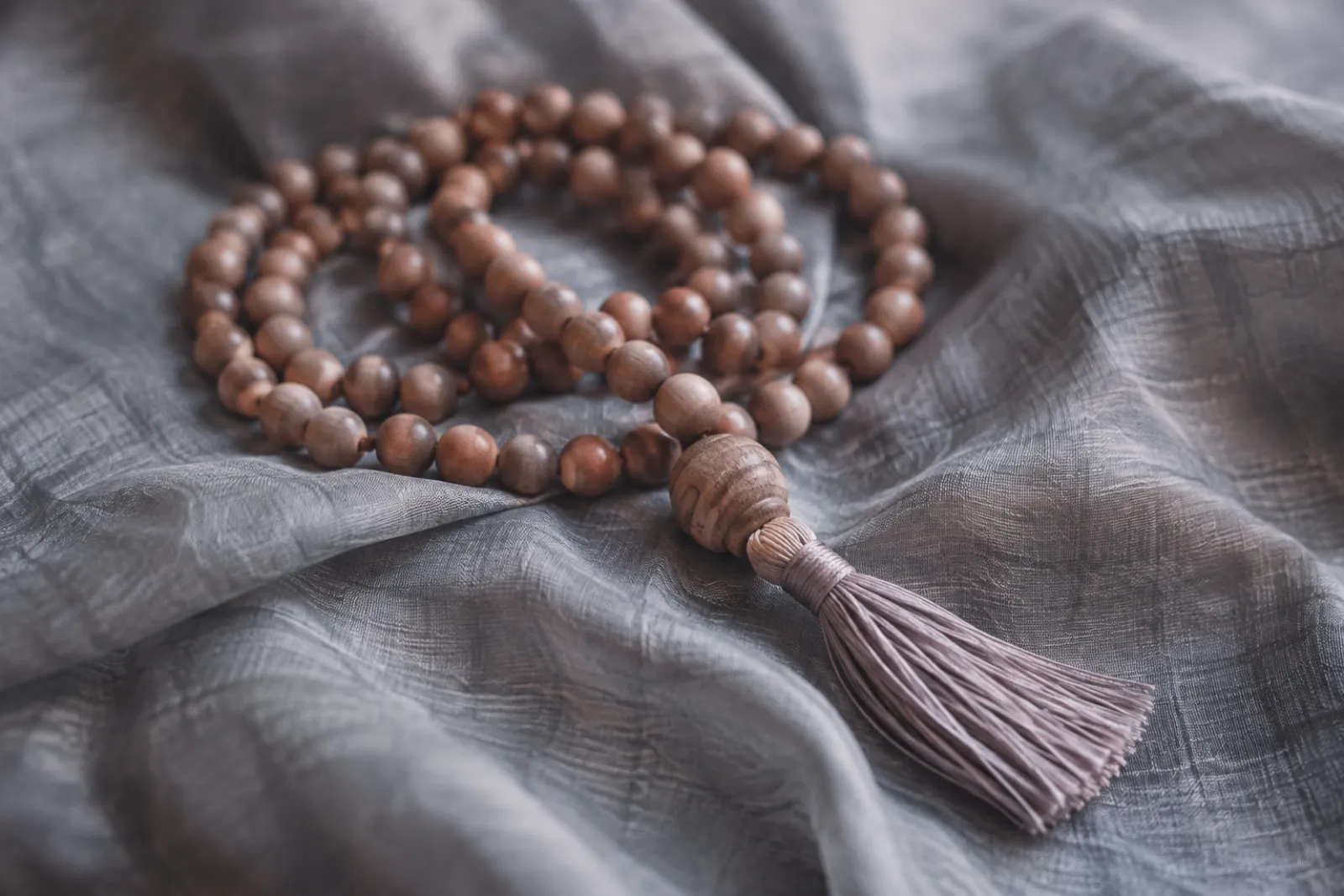
A sandalwood mala of 108 beads coiled on grey raw silk, the guru bead and tassel in focus, seen from above

01

What is a mantra and why does sound work as an anchor?

A mantra is a syllable, word or line repeated on purpose during practice. The Sanskrit root points at an instrument of the mind, and functionally that is accurate — it is a handle. Sound is a good anchor because it occupies the same inner channel that verbal thinking uses. Silent worry and silent repetition cannot both run at full volume, so the repetition crowds out the commentary in a way that watching the breath does not. Add the physical vibration of chanting aloud and you get a second, bodily anchor at the same time.

02

Three foundation sounds to start with

Om — said om, drawn out as a-u-m — the primordial sound, the whole of reality condensed into one syllable. Taken at the start and end of practice, and when you want one long simple thing to hold. So Hum — so-hum — translates as I am that, the breath itself saying so on the inhale and hum on the exhale. Taken for silent seated practice because it needs no voice. Om Shanti — om shan-tee — shanti means peace, usually repeated three times for peace in body, speech and mind. Taken to close a practice or to settle after conflict.

Four classical mantras from the living traditions

Om Mani Padme Hum — om ma-nee pad-may hum — the Tibetan mantra of compassion, usually rendered as the jewel in the lotus, associated with Avalokiteshvara. Taken when the practice is compassion, for yourself or for someone difficult. Om Namah Shivaya — om na-mah shi-va-ya — I bow to Shiva, the five-syllable mantra of the Shaiva tradition, associated with letting the old fall away. Taken during transitions and endings. Gayatri, first line — Om bhur bhuvah svah — om bhoor bhu-vah swah-ha — an invocation of the three worlds opening one of the oldest Vedic verses, a prayer for illuminated understanding. Taken at sunrise. Ram — rahm — a name of the divine held as a single syllable, repeated for steadiness and courage. Taken when fear needs something short.

Three mantras of intention and heart

Sat Nam — sat naam — truth is my name, or true identity, the core mantra of Kundalini yoga, sat long on the inhale and nam short on the exhale. Taken when you have been performing a version of yourself and want to stop. Lokah Samastah Sukhino Bhavantu — lo-kah sa-mas-tah su-khee-no bha-van-tu — may all beings everywhere be happy and free, and may my own life contribute to that. Taken to close a practice outward rather than inward. Aham Prema — a-ham pray-ma — I am divine love, a modern Sanskrit phrase rather than a scriptural one. Taken for self-compassion work, and worth knowing that its lineage is recent.

05

How do you practise japa with a mala?

Japa is counted repetition. A mala is a string of 108 beads with one larger bead, the meru or guru bead, that marks the start. Hold the mala in one hand, let it rest over the middle finger, and move bead to bead with the thumb, one repetition per bead, without crossing the guru bead — when you reach it you turn the mala around and go back. One full circuit is 108 repetitions and takes roughly ten to fifteen minutes at a calm pace. The beads exist so the counting is not another job for attention.

06

Does the meaning matter, or only the vibration?

Both claims exist and they deserve different treatment. Meaning clearly matters — repeating a line you understand shapes attention toward what it says, which is why compassion mantras are used for compassion practice. Vibration is the older and bolder claim, that specific syllables act on the body or on reality itself regardless of comprehension. There is no evidence for the metaphysical version. There is something real in the physical one — slow chanting lengthens the exhale and the audible hum is felt in the chest and skull, which is a genuine calming mechanism and an unremarkable one.

How do you use these sounds respectfully?

These are living liturgy for hundreds of millions of people, not sound pills sorted by symptom. Respect here is mostly ordinary courtesy. Learn what a phrase means before you repeat it ten thousand times. Do not promise it cures anything. Do not sell a syllable as a product. Pronounce it as well as you can and accept that your accent will be imperfect, which every tradition has always tolerated in sincere practitioners. If a mantra belongs to an initiatory lineage, a teacher gives it — you do not take it from a list, including ours.

Questions

What people ask before saying one out loud.

Do I have to say it out loud?

No. Three modes are traditional and all are legitimate — aloud, whispered, and silent in the mind. Aloud is the easiest for beginners because the sound gives attention something loud to hold, whispered is the usual middle setting, and silent is considered the subtlest and is the one you will use on a train. Start aloud when you are alone, move inward as the phrase becomes automatic.

Why 108?

The number is sacred across Indian traditions and is explained in many ways — astronomical ratios, the count of upanishads, nine times twelve. No single explanation is authoritative and the honest answer is that the number carries accumulated meaning rather than a proven origin. Practically it is a good length — one circuit is ten to fifteen minutes, long enough for the mind to settle and short enough to finish.

Can I use a phrase in my own language instead?

Yes, and it will work as an anchor. A short line you fully understand holds attention well, and many secular practitioners use exactly that. What you lose is the layer of transmission — a traditional mantra arrives with centuries of practice, a defined meaning and a community that uses it, which is part of why it steadies people. Also keep it short. Anything longer than about six words turns into thinking.

Is a mantra the same as an affirmation?

No, they are aimed at different things. An affirmation is a statement you repeat to influence belief about yourself, and it is evaluated by whether you start to believe it. A mantra is a sound you repeat to stabilise attention, and it is evaluated by whether attention stays. The two overlap in phrases like Sat Nam, which carries meaning and functions as an anchor, but confusing them leads to judging a mantra by whether it made you feel better, which is not its job.

Where next

A sound holds attention better than a rule does.

If a repeated sound is the anchor that suits you, the paid technique built on exactly that is worth understanding before you pay for it. And the plain method underneath all of this is ten minutes long.

Transcendental MeditationHow to meditateBack to meditation

Read here as a language of symbols. Medical, legal and financial questions belong with a professional.