retreat curatorby milena chernomorets

Retreats

Meditation Retreats: The bell decides everything

A cushion, the hours between, and what the body says about them.

A meditation retreat is a residential course where a teacher and a timetable take over your day so that you can practise far longer than you ever would at home. Sitting and walking alternate in blocks of about forty minutes, and time on the cushion adds up to five or ten hours a day. The style of practice shapes the week far more than the setting does.

A bell, a cushion, the hours betweenWhat the body does about it
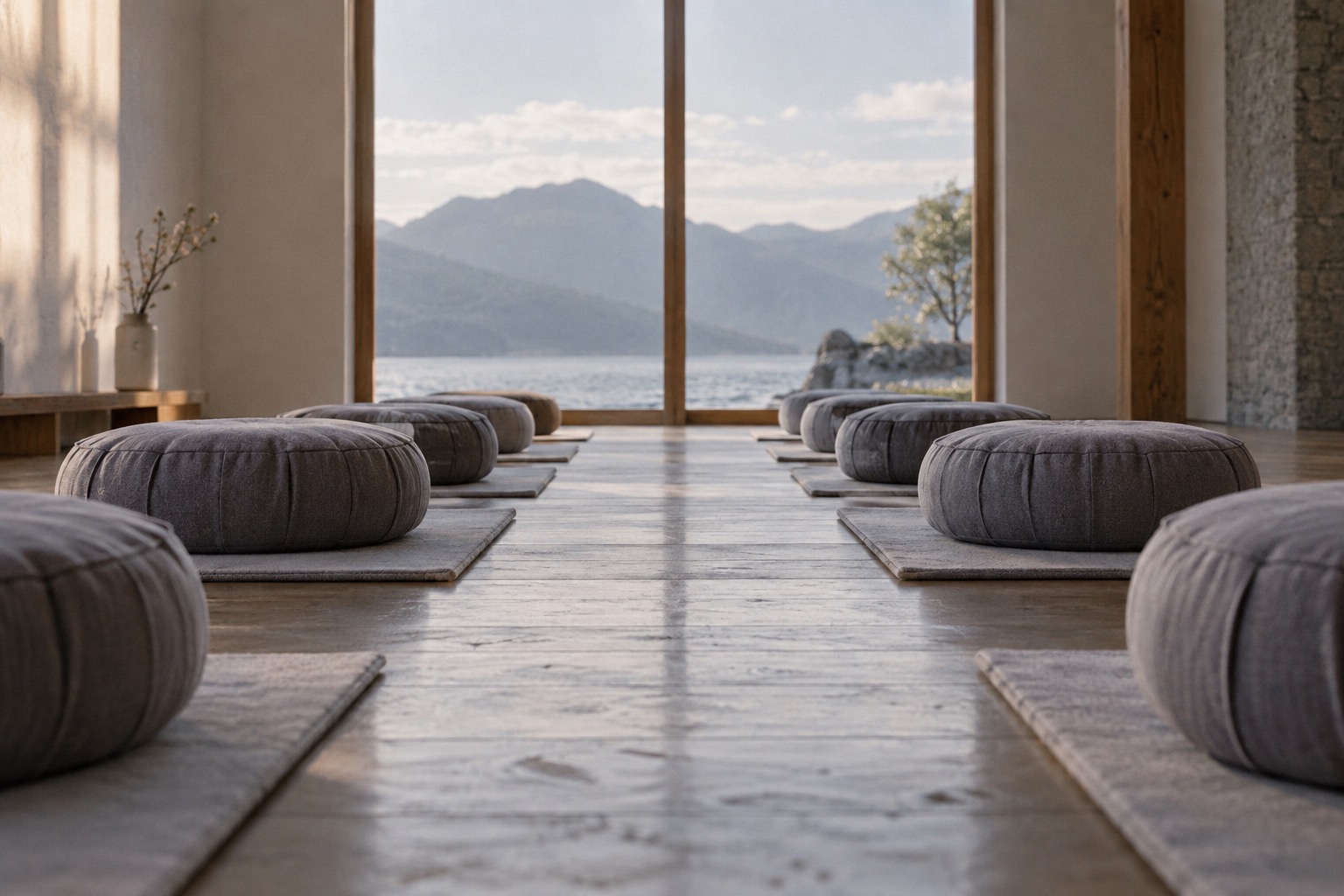
A row of identical zafu cushions in a hall, low angle, symmetrical, empty.

01

What does a day on a meditation retreat actually look like?

A bell wakes the house, usually somewhere between four and six in the morning, and from then on the bell decides everything. The first sit happens before breakfast, often before light. After that the day is a rhythm of sitting and walking: forty minutes on the cushion, then a slow walking period up and down a marked path or around the hall, which exists because knees have limits and because walking practice is practice, not a break. Meals are early and light, and in many traditions the last one is at midday. Somewhere in the afternoon there is a work period, an hour of chopping vegetables or sweeping, done in silence. In the evening the teacher gives a talk, sometimes the only voice you hear all day. Lights out comes early. What surprises most first-timers is not the effort but how completely the timetable removes decisions from your hands.


02

Which style of practice will you meet, and how do they differ in feel?

Vipassana and insight retreats work with sensation and with noticing what the mind does, moment by moment. The Goenka version is the strictest and most uniform, with a fixed ten-day arc and recorded instructions; the broader insight world, sometimes called Insight Meditation, is gentler in tone and usually taught live. Zen is about form. Posture matters, the hall has choreography, the bell and the bows are part of the practice, and sesshin days are long and deliberately plain. Tibetan retreats bring in visualisation, mantra, devotional practice and a relationship to a teacher and a lineage, which feels warm to some people and foreign to others. Secular mindfulness and teaching in the MBSR lineage keeps the attention training and leaves the cosmology out, which is why it turns up in hospitals and workplaces. Pick the tradition before you pick the view from the window, because the tradition is what you will be living inside.

What does sitting all day do to your knees and your back?

It hurts more than people admit, and mostly in ordinary ways. Hips tighten, the lower back complains around the thirty minute mark, one shoulder creeps up, and a foot goes numb. The idea that you must sit cross-legged on the floor is a picture, not a requirement. Chairs are normal, benches are normal, kneeling stools are normal, and lying down is allowed in many places if your back is genuinely bad. What matters is that the spine can hold itself without strain and that you are not bracing. Learn the difference between discomfort you can sit with and pain that is sharp, radiating or numbing, because the second kind is information and you should move. Stretch in the breaks, walk properly during walking practice instead of drifting, and tell the teacher early if something is getting worse. Ten days of quiet stoicism about a real injury helps nobody.

How do you get through a first retreat without burning out?

Choose shorter than you think you should. A five-day course finished well teaches you more than a ten-day course you left on the fourth morning. Choose a teacher who is reachable, someone with interviews or a daily question period, not a recording and a rulebook. Arrive without a goal. The people who suffer most are the ones who came to fix something specific by Friday, and they spend the week auditing their own progress instead of practising. Do not treat hours on the cushion as a score; adding extra sits at night mostly buys you exhaustion. Expect the second day to be the worst and do not read it as a sign you are unsuited to this. Sleep when the schedule says sleep, eat what is served, and follow the timetable even when it seems arbitrary, because the timetable is doing the thinking so that you do not have to.

05

How do you tell a good centre from a bad one?

A good centre tells you almost everything before you arrive. You get the actual daily schedule, not a mood description; the name of the teacher and their training and lineage; the technique you will be taught; the accommodation and whether rooms are shared; the food and what happens if you cannot eat it; and a clear statement about phones, silence and whether you may leave early. There is a health question on the form and someone reads the answers. There is a named person to go to if you are struggling at three in the morning. Warning signs are just as legible: vagueness about who is teaching, pressure to commit quickly, discouraging you from contacting family, mixing meditation with unrelated services or bodywork you did not ask about, a teacher spoken about in reverent terms by the staff, and no mention anywhere of what happens if a participant becomes unwell.

06

What happens to the practice after you go home?

It shrinks, and that is the normal result rather than a personal failure. A retreat gives you conditions you cannot reproduce in a flat with a job and a phone, so the clarity fades over a week or two once the conditions go. What survives is smaller and more useful: a technique you now actually know how to do, a sense of what your own mind does when it is left alone, and the discovery that twenty minutes is not nothing. Set a time you will genuinely keep rather than the hour you managed on retreat. Many centres run sitting groups or online sessions, and having other people expecting you is worth more than willpower. Resist the urge to convert anyone. And if the retreat left you rattled rather than settled, say so to the teacher or to a therapist; that outcome happens and it is worth talking about rather than filing away.

Where to go

Centres with a lineage and a schedule you can read

Real places that run this themselves, on their own ground, with their own dates and programs.

Esalen Institute

Big Sur, California

Workshop campus on the Big Sur cliffs, with clifftop hot springs and programs running since 1962.

WellnessMeditationYoga

their site

Spirit Rock Meditation Center

Woodacre, California

Insight meditation center in Marin County with residential retreats in the Theravada tradition.

MeditationSilence

their site

Green Gulch Farm Zen Center

Muir Beach, California

Coastal Zen practice center and organic farm, one of the three San Francisco Zen Center sites.

MeditationSilence

their site

Tassajara Zen Mountain Center

Carmel Valley, California

Zen monastery in a remote canyon with natural hot springs; opens to guests in the summer season.

MeditationSilence

their site

1440 Multiversity

Scotts Valley, California

Campus in the redwoods with weekend programs on mindfulness, relationships and work.

WellnessMeditationYoga

their site

Deer Park Monastery

Escondido, California

Plum Village monastery in the hills north of San Diego; retreats and days of mindfulness with the monastics.

MeditationSilence

their site

The Expanding Light Retreat

Nevada City, California

Retreat of the Ananda community in the Sierra foothills, teaching in the lineage of Paramhansa Yogananda.

MeditationYoga

their site

Mount Madonna Center

Watsonville, California

Community-run center above Monterey Bay with yoga, Ayurveda and seasonal programs.

YogaMeditationWellness

their site

The whole directory

An honest boundary

When this belongs with a specialist rather than a practice

Intensive practice destabilises some people, and that is not a rumour. Surveys and interview studies of experienced meditators have documented adverse effects, including anxiety, depersonalisation, insomnia, intrusive memories and periods of low mood that outlast the retreat, and teachers who have been at this a long time will confirm it. The acute states belong with a clinician before they belong in a meditation hall: active psychosis or a history of it, current mania or unstable bipolar illness, severe untreated depression, suicidal thinking, acute grief in its first weeks, an active eating disorder, recent trauma without support, and withdrawal from alcohol or drugs. None of this is about willpower or readiness. If you are on medication or in treatment, tell your clinician what you are planning and tell the centre the truth on the form. If something frightening starts during a retreat, say it out loud to the teacher that day rather than sitting through it.

Questions

What people ask about sitting for days.

Do you need experience to go on a meditation retreat?

For most beginner courses, no. Ten-day Vipassana courses in the Goenka tradition are designed for people who have never meditated, and insight and mindfulness centres run explicit introductory retreats. What helps is a few weeks of short daily sitting beforehand, twenty minutes or so, just so the posture and the boredom are not both new at once. Avoid advanced retreats, long self-directed sits and anything described as a deepening course until you have finished a taught one.

Is a meditation retreat always silent?

Usually, at least partly. Vipassana courses and Zen sesshin hold silence throughout, apart from talking to the teacher. Many insight and secular retreats keep silence between sessions but allow small group discussion, a daily check-in or questions after the evening talk. Some family and beginner formats are not silent at all. The listing should say plainly which it is, and if it does not, ask before you book, because this single detail changes the whole week.

How long should a first meditation retreat be?

Three to five days is a sensible first course for most people. It is long enough to get past the initial restlessness and short enough that you can hold your life together around it. Ten days is the classic format and plenty of beginners do it as their first retreat without trouble, but it asks a lot if you are exhausted or going through something difficult. Finishing a shorter course well is a better foundation than surviving a long one.

What does a meditation retreat cost?

It depends on the tradition, the country and whether you share a room, and the models differ more than the numbers do. Vipassana courses in the Goenka tradition run on donation, with nothing charged for teaching, food or lodging. Many insight centres charge for room and board and leave the teaching itself on a donation basis for the teacher. Secular and hotel-based retreats price like ordinary bookings. Our page on what a retreat costs explains how each model works.

Where next

The centre matters more than the method.

Lineage, teacher, room, rules, and what the place does when somebody has a hard night. The directory names real centers and links to each one, and the cost page covers what the stay asks of you.

A week after which the thing that would not move for years has finally moved.

Go on a retreat with Milena

Read here as a language of symbols. Medical, legal and financial questions belong with a professional.