retreat curatorby milena chernomorets

Retreats

Yoga Retreats: Your body notices by Wednesday

A week in which the practice sets the day from the first morning.

A yoga retreat is a week in which practice sets the shape of the day rather than sitting on a list of activities. You practise twice, morning and late afternoon, with meals, rest and breathwork arranged around those two anchors, and one teacher usually carries the whole programme, so the sessions build on each other instead of restarting every single morning.

Retreat or holiday with classesHow to read a programme
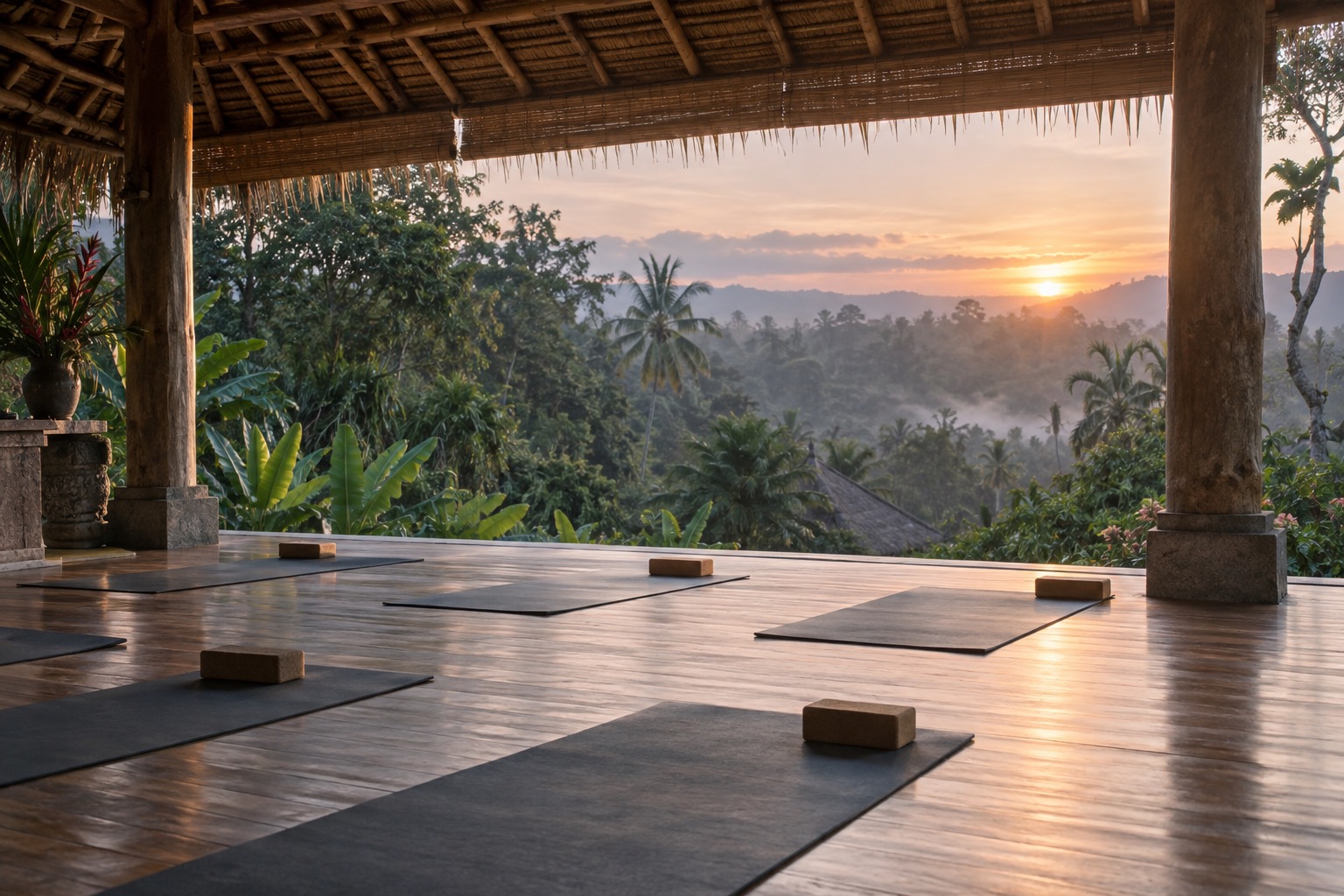
An open shala with a wooden floor and mats laid out, jungle beyond, dawn, empty.

01

What makes it a retreat and not a holiday with two classes?

Plenty of resorts sell a yoga holiday. There is a shala, a timetable on the noticeboard, and a rotating cast of teachers who take whoever turns up that morning. You can have a good week there and nobody should sneer at it. A retreat works differently. The group arrives together and leaves together, so on Thursday the teacher still knows what she gave you on Monday and can build on it. The practice sets the shape of the day instead of fitting around the beach, which is why sessions sit early and late and the hot middle hours are left open. There is usually some silence, sometimes only at breakfast. Food, sleep and rest are treated as part of the method rather than as hotel services. The simplest test is whether the week has a spine, one teacher and one arc and one group, or whether it is a menu you pick from.


02

Which style are you actually signing up for, and how does a whole week of it feel?

Hatha and slow flow hold poses long enough for you to hear your own breathing, and a week of it leaves you loosened rather than wrung out. Vinyasa moves continuously and lifts your heart rate; by day four your shoulders will have opinions. Ashtanga is a set series in a fixed order, usually before sunrise, six days with one day off, and the repetition is the point, because you stop deciding what comes next and start noticing what changed. Iyengar uses belts, blocks and a wall, holds longer and corrects precisely, and people who arrive with a cranky knee often get the most from it. Yin holds floor shapes for minutes at a time and reaches connective tissue, which is quieter and harder than it sounds. Restorative is propped and nearly still. Kundalini adds repetitive movement, breath work and chanting. Hot styles add heat and heavy sweating and are the least forgiving in an unfamiliar climate.

How many hours a day is it, and what happens to a body that suddenly practises this much?

Two practices a day is the common shape: something longer and more active in the morning, something slower in the late afternoon, three to four hours of mat time in total. Add meditation, breathwork and a talk and you are at five or six scheduled hours, which is a full day even when half of it is lying down. A packed programme with three practices, a workshop and an evening session leaves no hours that belong to you, and that is a real difference worth checking before you pay. If you normally practise once or twice a week, a retreat multiplies that overnight. Day one feels great. Day three you are stiff in places you never think about, your wrists complain and your sleep goes deep and strange. Skipping an afternoon session is not a failure. On any sensible programme somebody skips one every day, and the teacher expects it.

How do you read a programme honestly before you book?

Ask for the timetable hour by hour, not a paragraph of atmosphere. You want start times, session lengths and what sits between them. Check whether afternoons are genuinely free or quietly filled with optional things everyone attends. Find out whether the named teacher teaches every session or appears twice and hands the rest to local staff. Both happen, and only one of them matches what was advertised. Look at whether there is meditation and pranayama at all or only asana, because that changes the week completely. Ask how beginners and experienced practitioners are handled: one mixed room with variations offered, or separate tracks. Ask about food, since a week of raw vegan meals is a different experience from a week of cooked local dishes and neither is wrong. Ask the group size and the maximum. A small group and a full hall are not the same retreat, whatever the photographs suggest.

Where to go

Places where the practice sets the day

Real places that run this themselves, on their own ground, with their own dates and programs.

Esalen Institute

Big Sur, California

Workshop campus on the Big Sur cliffs, with clifftop hot springs and programs running since 1962.

WellnessMeditationYoga

their site

1440 Multiversity

Scotts Valley, California

Campus in the redwoods with weekend programs on mindfulness, relationships and work.

WellnessMeditationYoga

their site

The Expanding Light Retreat

Nevada City, California

Retreat of the Ananda community in the Sierra foothills, teaching in the lineage of Paramhansa Yogananda.

MeditationYoga

their site

Mount Madonna Center

Watsonville, California

Community-run center above Monterey Bay with yoga, Ayurveda and seasonal programs.

YogaMeditationWellness

their site

Sivananda Ashram Yoga Farm

Grass Valley, California

Classical Sivananda ashram with a fixed daily schedule of asana, satsang and karma yoga.

YogaMeditation

their site

Miraval Arizona Resort & Spa

Tucson, Arizona

All-inclusive wellness resort in the Catalina Foothills with mindfulness, equine and spa programming.

WellnessCouplesYoga

their site

CIVANA Wellness Resort & Spa

Carefree, Arizona

Wellness resort north of Scottsdale where a daily schedule of classes is included in the stay.

WellnessYogaCouples

their site

Drala Mountain Center

Red Feather Lakes, Colorado

Mountain retreat center with the Great Stupa of Dharmakaya, formerly known as Shambhala Mountain Center.

MeditationYogaSilence

their site

The whole directory

05

Who is a yoga retreat right for, and can you come as a complete beginner?

Yes, a beginner can go, with one condition: the retreat has to say it welcomes beginners and mean it. In a mixed room a decent teacher gives you a simpler version, keeps half an eye on you, and you will be fine by midweek. On an Ashtanga intensive or an advanced week you will spend seven days feeling behind, which is a miserable way to start. Retreats suit people who already know they want more practice than ordinary weeks allow, people coming back after an injury or a long gap, and people who want a week whose structure somebody else built. They suit less well anyone hoping to be repaired by a schedule, or travelling with a partner who has no interest in yoga and will be bored by Tuesday. If what you mainly want is rest, a Yin or restorative week will serve you better than a strong vinyasa one.

06

What should you sort out before you arrive?

Arrive a day early if you are crossing time zones, because a first morning practice on four hours of broken sleep sets the tone for the whole week. Bring your own mat if you care about grip, since house mats are usually tired. Pack layers for early mornings even somewhere hot, because a body that has been still for twenty minutes gets cold. Any injury, recent surgery, pregnancy or medication that affects your balance has to be on the table before you pay, along with a straight answer on whether the programme can work with it. The same goes for what happens if you need to miss sessions. On money there is no single useful answer, since season, country, room type, teacher and group size move it more than anything else, so read the site's page on what a retreat costs and compare like with like instead of headline against headline.

An honest boundary

When this belongs with a specialist rather than a practice

If you have a joint that already gives way or dislocates, a diagnosed disc problem, osteoporosis, uncontrolled high blood pressure, recent surgery, or you are pregnant, talk to your doctor or a physiotherapist before you book rather than after you land. And watch for the habit this setting encourages: pushing into pain because a teacher put a hand on your back, or because the woman on the next mat is folding further. Sharp pain, numbness or tingling down a limb means stop, not breathe through it. Tell the teacher on day one, in person, before the first class and not after something has torn.

Questions

What people ask before a yoga week.

How long should a first yoga retreat be?

Five to seven days is the honest answer for a first one. A long weekend is mostly arrival, one good practice and departure, and you go home before the interesting part starts, which is usually the third or fourth day when your body stops arguing. Two weeks is a lot to commit to a teacher you have never met. Seven days gives you a full arc with room to have a bad day in the middle and still recover from it.

Do I need to be flexible or strong already?

No. Flexibility is an outcome of practice, not a ticket to it, and stiff people often work more carefully and get hurt less. What helps far more is basic stamina for sitting and standing for a few hours a day, and the willingness to take the easier variation in front of a room. If you can walk for an hour without dreading it, you have enough to start. Tell the teacher what your body does not do, and she will give you a version that works.

Can I skip a session without it being a problem?

On a well-run retreat, yes, and it is better to say so than to disappear. Tell the teacher at breakfast that you are sitting out the afternoon, and that is the end of it. What is worth watching is the retreat where skipping is quietly treated as weakness, because that atmosphere is exactly what leads people to practise on an injury. Ask before you book how the programme handles a day off, and listen to how the answer is phrased.

Is it strange to go alone?

Most people on a yoga retreat came alone, which is precisely why it is one of the easier ways to travel solo. The timetable does the social work for you: you eat at the same table twice a day and practise in the same room for a week, so conversation happens without anyone having to arrange it. If you want a shared room, ask whether they pair single bookings and with whom. If you want to be left alone, say that once at the start and it is usually respected.

Where next

By Wednesday your body tells you which week you booked.

Two practices a day, a named teacher and an honest level description are worth more than the photographs. The directory links to centers that publish all three, and the cost page explains the figure.

A week after which the thing that would not move for years has finally moved.

Go on a retreat with Milena

Read here as a language of symbols. Medical, legal and financial questions belong with a professional.