retreat curatorby milena chernomorets

Tarot

Tarot Spreads: 8 Layouts and What Every Position Asks

A spread is a set of positions, and a position is a question. Lay the cards in a fixed order and each one answers something specific instead of speaking in general, which is the whole difference between a reading and a pile of pretty pictures. Choose the smallest layout the question needs: more cards give you more to argue with, not more clarity.

8 layouts1 to 10 cardsEvery position written out
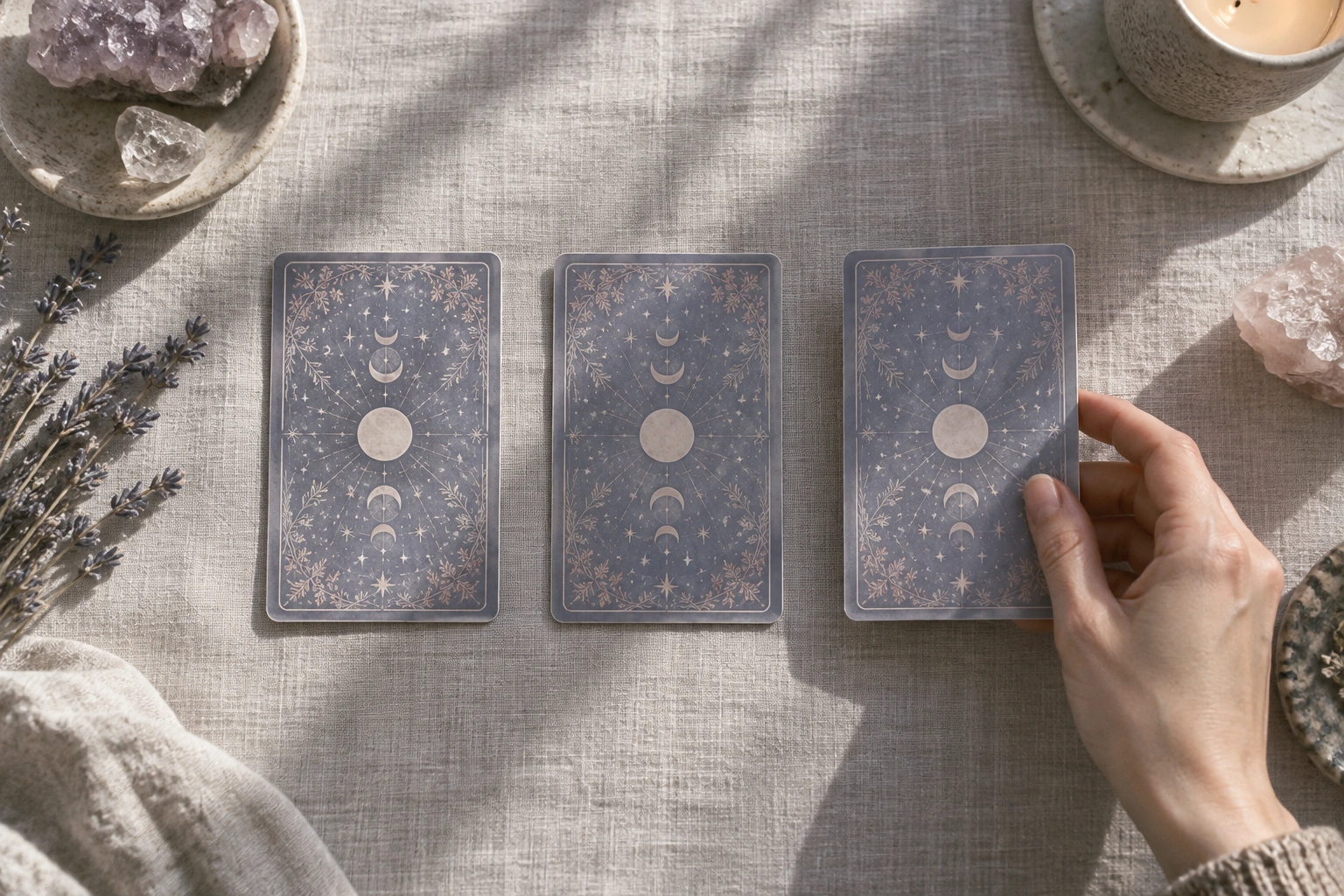
Three cards laid backs up in a row on linen, seen from above, a hand lowering the third

Start here

Three layouts that work from the first evening.

One card for a day, three for a story with a history, three more for a decision you keep renegotiating. Learn these and most questions are already covered.

One Card Daily

One cardA two minute morning ritual that teaches you the deck

One card, one morning, one theme to carry through the day. You are not asking what will happen, you are asking what deserves your attention. Pulled daily, this single card teaches you the deck faster than any book.

A card turned face up in this position1Today's theme
  1. 1Today's themeWhat deserves my attention today?

One card in the middle of the table

How to read it. Write one line about the card in the morning and one line in the evening. After a month you have your own dictionary, in your own words.

Three Card Past Present Future

Three cardsA fast read on where a situation came from and where it is heading

Three cards, left to right. The first shows what shaped the situation, the second what is alive in it right now, the third where it leads if nothing changes. It is the quickest way to see a whole story instead of one frozen moment.

A card turned face up in this position1Past
2Present
A card turned face up in this position3Where it leads
  1. 1PastWhat brought this situation to where it is now?
  2. 2PresentWhat is really going on for me today?
  3. 3Where it leadsWhat unfolds if I keep going exactly as I am going?

Left to right, from the past to where it leads

How to read it. Read all three as one sentence first, then take them apart. The story between the cards says more than any single card.

Yes or No

Three cardsA question that needs a straight answer, not a mood

Three cards for a decision you keep arguing with yourself about. Upright cards lean yes, reversed lean no, and the majority carries the answer, while the cards themselves name the condition attached to it. It works best when you already sense the answer and need to stop negotiating.

A card turned face up in this position1The answer
2What it depends on
3What I am not saying
  1. 1The answerYes or no, in one card?
  2. 2What it depends onWhat has to be true for this to work?
  3. 3What I am not sayingWhat am I leaving out of the question?

The answer first, then what it rests on

How to read it. Ask something you could answer with one word. A vague question gives a vague answer, and that is on the question, never on the cards.

The deep one

Celtic Cross

Ten cards, and the only layout here that asks for an hour. Lay it out when a three card read keeps coming back and you are still circling.

Celtic Cross

Ten cardsA question you have been circling for weeks

The classic ten card layout for a situation with many moving parts. It gives you the heart of the matter, what is pushing against it, what is already leaving, and how the people around you are involved. Give it an hour, it rewards slow reading.

A card turned face up in this position1The heart of it
2What crosses it
3The root
4What is passing
5What I aim at
6What comes next
7How I show up
8The people around me
9Hopes and fears
A card turned face up in this position10Where it settles
  1. 1The heart of itWhat is this situation actually about?
  2. 2What crosses itWhat is pushing against me right now?
  3. 3The rootWhat older story is lying underneath this one?
  4. 4What is passingWhat is already leaving, even if I still hold on to it?
  5. 5What I aim atWhat do I say I want here?
  6. 6What comes nextWhat is moving toward me in the coming weeks?
  7. 7How I show upHow am I actually behaving in this situation?
  8. 8The people around meHow do others see it and what pressure do they add?
  9. 9Hopes and fearsWhat am I quietly hoping for and quietly dreading?
  10. 10Where it settlesWhere does this land if I stay honest with myself?

One and two the core, three to six the sides, seven to ten the column

How to read it. If ten cards feel loud, read them in pairs. The heart with what crosses it, the root with what is passing, how I show up with the people around me.

For a specific life

Four layouts shaped around what you are actually asking.

Love, work, a situation with other people in it, and the month ahead. Same rule as before, the question decides the layout, never the mood.

Love and Relationship

Five cardsOne relationship you keep replaying in your head

Five cards for a single relationship, romantic or not. It splits the read into your side, their side and what actually lives between you, and the surprise is almost always in the middle. Good for a knot you keep retying instead of untying.

1You
2Them
A card turned face up in this position3Between you
4What blocks it
5What it needs
  1. 1YouWhat am I bringing into this?
  2. 2ThemWhat is their side of it, as far as I can honestly see?
  3. 3Between youWhat lives in the space between us?
  4. 4What blocks itWhat keeps this from being simple?
  5. 5What it needsWhat would change this most if I actually did it?

Two columns facing each other, the shared axis between them

How to read it. Do not pull cards to read another person's mind. The honest version of this spread is about what you do with what you feel.

Career Path

Five cardsStanding between two work options and stalling

Five cards for work, money and direction. It looks at where you stand, what you are genuinely good at, what keeps costing you and what the next real step is. Ask it when you are choosing, not when you want permission for a choice already made.

1Where I stand
A card turned face up in this position2My strength
3What holds me back
A card turned face up in this position4The next step
5Where it can grow
  1. 1Where I standWhat is true about my work right now?
  2. 2My strengthWhat am I genuinely good at here?
  3. 3What holds me backWhat keeps repeating and costing me?
  4. 4The next stepWhat is the smallest real move from here?
  5. 5Where it can growWhat opens up if I actually take that step?

One step up for every card

How to read it. Name both options out loud before you shuffle. A read with a clear question becomes a decision, a read with a vague one becomes a mood.

Horseshoe

Seven cardsA full picture without committing to ten cards

Seven cards in an arc for a situation with several players in it. It covers what came before, what is here, what is hidden, your own part, other people, the advice and the likely direction. A good middle ground between three cards and the celtic cross.

1The past
2The present
A card turned face up in this position3What is hidden
4My part in it
A card turned face up in this position5Other people
6The advice
7Where it is heading
  1. 1The pastWhat set this in motion?
  2. 2The presentWhere does the situation stand today?
  3. 3What is hiddenWhat am I not seeing yet?
  4. 4My part in itWhat am I contributing, for better or worse?
  5. 5Other peopleHow are the others shaping this?
  6. 6The adviceWhat is the wisest thing I can do now?
  7. 7Where it is headingWhat direction does this take if I follow the advice?

Seven cards along the arc, left to right

How to read it. The advice card is the one to act on. Everything before it is context, and context alone has never changed anything.

New Moon

Six cardsSetting an intention at the start of a lunar cycle

Six cards for the dark moon, when you are starting something rather than finishing it. It names what closed, what you are done carrying, what you are planting and what already supports you. Pull it monthly and the readings start talking to each other.

1What closed
A card turned face up in this position2What to release
A card turned face up in this position3The seed
4How to tend it
5The support
6By the full moon
  1. 1What closedWhat ended in the cycle behind me?
  2. 2What to releaseWhat am I done carrying?
  3. 3The seedWhat am I planting this month?
  4. 4How to tend itWhat does this need from me week by week?
  5. 5The supportWhat is already helping me, even unnoticed?
  6. 6By the full moonWhat can become visible in two weeks?

A crescent from what closed to the full moon

How to read it. Photograph the cards and come back to them at the full moon. Half the value of this spread lives in the rereading.
Questions

Asked most often about spreads.

Which tarot spread should a beginner start with?

One card daily, then the three card past present future. The single card teaches you the deck without pressure, and three cards teach you the thing that actually matters, reading cards as one story instead of three separate verdicts. Move to bigger layouts only when a three card read genuinely runs out of room.

Can I make up my own tarot spread?

Yes, and readers do it constantly. Write the questions first, one per position, and keep them different enough that two cards cannot answer the same thing. Three to five positions is the sweet spot. If you cannot say out loud what a position asks, that position does not belong in the layout.

What if a card makes no sense in its position?

Say what you see on the card out loud, then read it against the question of that position rather than against the meaning you memorised. A card that seems wrong is usually answering the question more honestly than you wanted. Note it down and come back in a week, those are the entries that teach you the most.

Where next

A layout is only as good as the question you brought to it.

If you came for a straight answer, the three card yes or no is quicker. If a card in your spread is unfamiliar, the library has all seventy eight of them, upright and reversed.

Yes or no readingAll 78 card meaningsCard of the dayHow to read tarot

Read here as a language of symbols. Medical, legal and financial questions belong with a professional.

A candle in a holder, a cup and three cards face down on a table