Citrine: Meaning, Properties and How to Use It
Citrine is the money stone of modern practice, and the one tradition ties to nerve rather than luck. It is credited with steadying you when you name a price, ask for a raise or start something before you feel ready. Old texts call it the merchant's stone because shopkeepers kept it in the till.
What tradition says
What is Citrine known for?
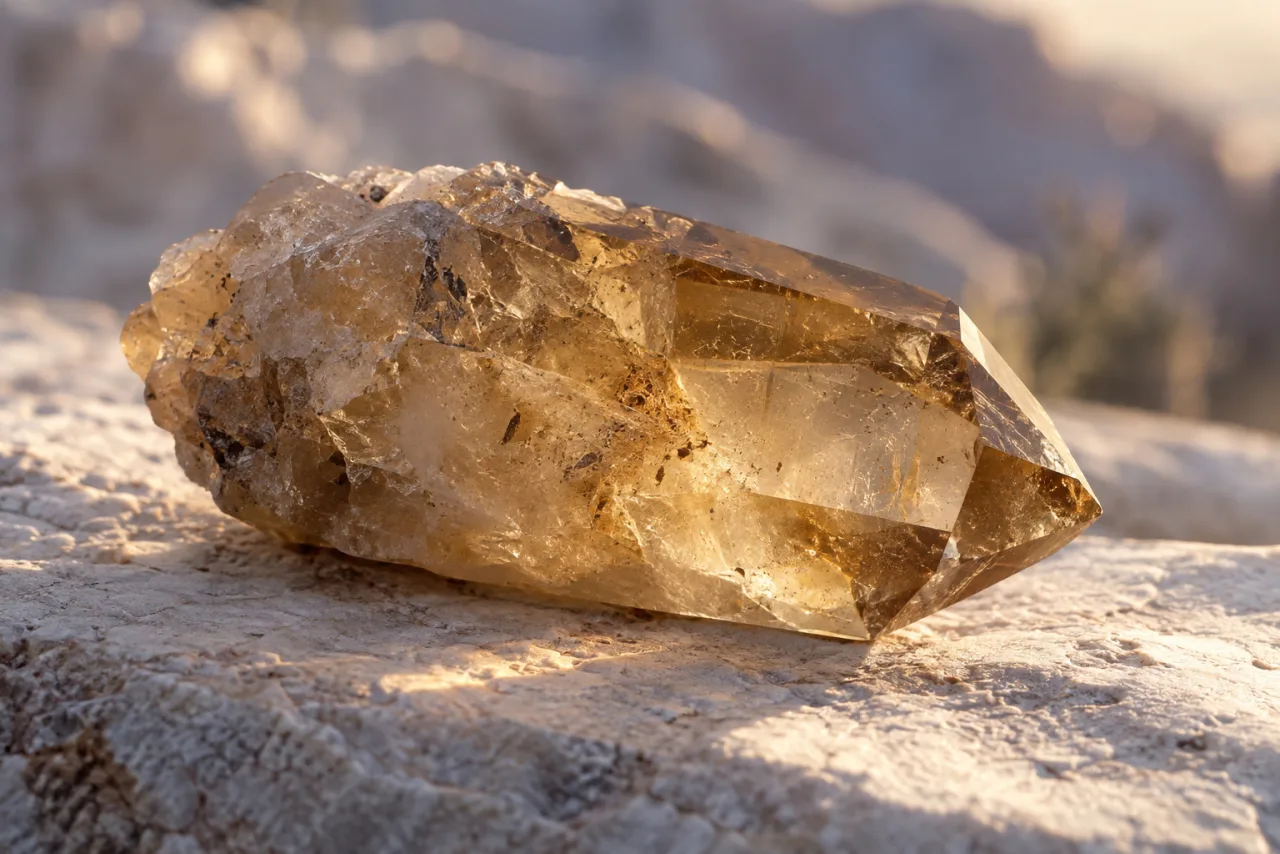
Natural citrine is rare and usually a smoky honey colour rather than bright orange. Most of what is sold was amethyst until a furnace changed it, a treatment the trade has used since the eighteenth century and does not hide. The lore is straightforward and commercial. Citrine is the stone of the person who has to earn, and unlike most stones writers insist it never needs cleansing because it holds nothing heavy.

The practice
How do you use Citrine?
Keep a small piece in your wallet, in the till or taped inside the drawer where invoices live.
Hold it for a minute before a call about money and say the number out loud once while you do.
Some people keep one to the left of the desk, the side tradition assigns to receiving.


Read here as a language of symbols. Medical, legal and financial questions belong with a professional.
Two more
What does Citrine pair with?
Stones are kept in small sets rather than alone, and these two are the usual company for this one.
What it is kept for
What do people reach for Citrine for?
The same stone, read through the thing you came here with.
Questions
What else do people ask about Citrine?
How do I tell natural citrine from heated amethyst?
Heated stones usually have a white base and a sharp orange top, and often keep the crystal shape of an amethyst geode. Natural citrine is evenly pale, smoky or lemon, with no chalky zone. Price tells you too. A cheap deep orange cluster is heated, every time.
Does citrine need cleansing?
Tradition says no, and this is one of the few stones where the writers agree with each other. If you want a reset anyway, a short rinse and a night in the dark is enough. Skip sunlight, which is the one thing that actually harms it.
Next in the library
The stones beside this one.
Two ways on
One stone is a reminder, a library is a map.
A hundred and four stones and sixty four everyday uses, sorted the way a week arrives. If you came here through the body rather than the mineral, the seven chakras are the other way in.
- 104
- stones, each with what tradition says
- 64
- everyday uses, six stones under each
- 7
- centres, the same set read through the body