You knew the answer on the first day and spent three months looking for permission.
Third Eye Chakra: Meaning, Blocked Signs and How to Open It
Ajna is placed between the brows and the tradition credits it with seeing, in the sense of understanding rather than eyesight. Hunches, mental images, dreams and the quiet ability to tell a real signal from wishful thinking are all said to belong here. Older texts call it the command centre, the place where the teacher inside finally becomes audible. Remember what kind of map this is, an inner geography kept by yoga for training attention, not a diagram of tissue.
Sanskrit AjnaMantra OMIndigo in the modern systemBetween the brows, a little above the bridge of the nose.
Read from the bottom up, base of the spine first and crown last. The petals grow with the count.
How this is described
What do people mean by a blocked third eye chakra?
Four descriptions people give, borrowed from the way the tradition talks. None of them is a test, nothing here is measurable, and a state that lasts belongs to a doctor rather than to a diagram.
Decisions get postponed by one more article, one more opinion, one more list of pros.
Nothing feels vivid, days blur, and you cannot picture next spring at all.
You trust every expert in the room more than the thing you noticed first.
Three practices
What to actually do this week.
Short, repeatable and dull on purpose. Ten to fifteen minutes a day for a week does more than one long session you never repeat.
Alternate nostril breathing, eight rounds
Sit comfortably, close the right nostril with the thumb, breathe in through the left for four counts. Close the left, release the right, breathe out for six. Reverse and repeat, eight full rounds. Keep the fingers light on the face and the shoulders down. Stop at once if you feel lightheaded and breathe normally.
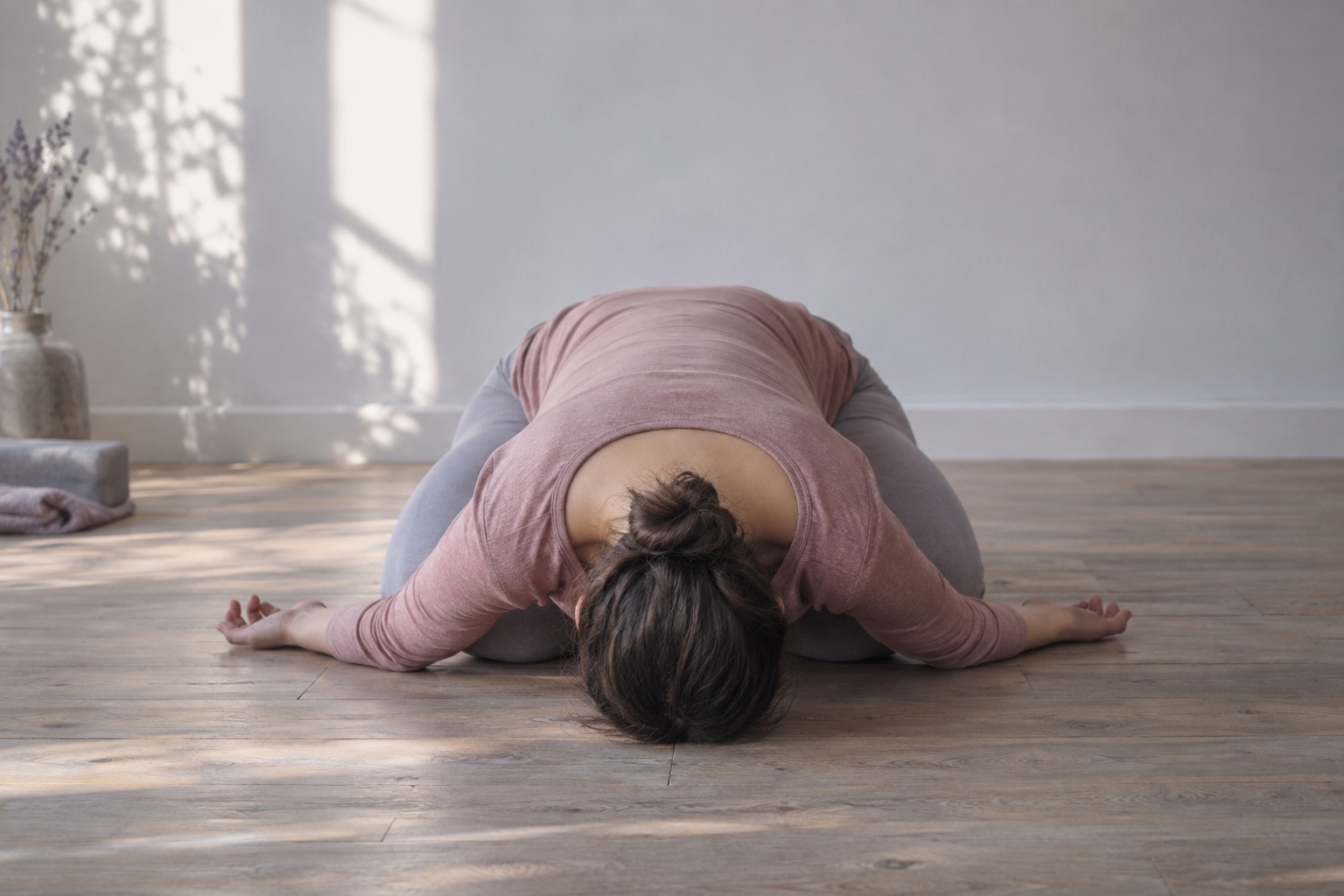
Forehead on the floor, five minutes
Kneel, sit back on the heels and fold forward until the forehead rests on the mat or on a stacked pair of books. Stay five minutes with the arms heavy beside you. The point is contact, the small steady pressure at the brow, which most people find settles thinking faster than any instruction to stop thinking.
Humming with the ears closed
Close the ears with the thumbs, rest the fingers lightly over the eyes, and hum on each exhale for seven rounds. Keep the mouth shut so the sound fills the head rather than the room. Between rounds leave a few seconds of silence and notice where the buzz settles. Finish by lowering the hands slowly.
Three stones
Which stones are given to the third eye chakra?
What the tradition hands you for this centre, and why each one. Three names, three reasons, and the reason matters more than the name.
Three postures
Where the body meets the theme.
One standing, one opening, one resting. Take them slowly, breathe into the area the centre is placed in, and stop where the stretch turns into pain.
Ardha Pincha Mayurasana, dolphin pose
Forearms down, hips up, and the head hangs free, so keep the neck soft rather than braced.
Garudasana, eagle pose
Wrapping the limbs narrows the field of balance, which is why it pulls scattered attention into one line.
Prasarita Padottanasana, wide-legged forward fold
The crown drops towards the floor, and five slow breaths there are usually enough to change the mood.
Questions
What people ask about the third eye chakra.
How do I tell intuition from anxiety?
People who practise report a difference in texture. Intuition tends to be quiet, brief and oddly unemotional, and it does not need you to agree with it. Anxiety repeats, argues and grows louder the more attention it gets. That is a rule of thumb from self-observation, not a test, and a strong anxiety pattern is worth taking to a professional.
Is it dangerous to open the third eye?
The horror stories usually come from long retreats, sleep deprivation and hours of intense breathwork, not from ten minutes of sitting. Keep the dose sensible and you are doing something unremarkable. If practice leaves you unable to sleep, frightened, or unsure what is real, stop and talk to a doctor. Intensity is not a sign of progress.
I do not see anything when I close my eyes. Does that mean something is wrong?
No. Some people think in pictures and some do not, and the difference has a name, aphantasia, and a perfectly ordinary life attached to it. Every practice on this page works on sensation and sound as well as imagery. Follow the version that is available to you and drop the instruction to visualise anything.
The other six
Which centre is loud for you this week?
Two ways on
A centre opens through a week of small repetitions, not through reading.
Ten minutes, the same ten every day: breath into one area, one posture, one syllable, five minutes of writing. A week of that moves more than an evening of reading.
Work with one centreSit for ten minutesBack to the seven
Read here as a language of symbols. Medical, legal and financial questions belong with a professional.